

IICRC S520 Certified · Bellevue, WA · 24-Hour Mold Window
Mold Remediation in
Bellevue, WA
Bellevue’s 65–80% winter humidity means mold begins colonizing wet materials within 24 hours of water damage — faster than any other market in Washington State. IICRC S520 containment, HEPA air scrubbing, clearance testing. Covered by homeowners insurance.
✓ IICRC S520 Protocol ✓ HEPA Containment ✓ Clearance Testing Before Reoccupancy ✓ Insurance Documented
Quick Answer
how quickly does mold grow After Water Damage in Bellevue, WA?
Mold begins colonizing wet materials within 24 to 48 hours of a water damage event. In Bellevue’s Pacific Northwest climate — where outdoor relative humidity runs 65–80% from October through March — that window compresses closer to 20–24 hours. Aspergillus, Penicillium, and Cladosporium are the most common species found in Bellevue homes after water events. All three grow on drywall, insulation, wood framing, and carpet within one to two days of moisture exposure.
Same-day water extraction eliminates mold risk on most jobs. When mold is discovered — during moisture mapping, during drying, or after a delayed response — IICRC S520 remediation protocol is required. This is not optional cleanup. It is a structured, certified process with containment, source removal, air filtration, and clearance testing.
20–24 hr
Bellevue mold window
Oct–Mar high-humidity season compresses standard 48hr window
65–80%
Winter outdoor humidity
Bellevue Oct–Mar. Accelerates colonization vs. drier markets.
3 species
Most common in Bellevue
Aspergillus, Penicillium, Cladosporium — all found in Crossroads/Lake Hills homes
$2K–$8K+
Added remediation cost
Vs. $0 when same-day extraction prevents mold growth entirely
Bellevue Mold Risk
Why Bellevue Has Elevated Mold Risk After Water Damage
Three Bellevue-specific factors make mold growth faster and more likely here than in drier Washington markets.
🌿 Kelsey Creek & Mercer Slough Humidity
Crossroads, Lake Hills, and Wilburton sit adjacent to Kelsey Creek (watershed) and Mercer Slough (367 acres of wetlands). These water features elevate ambient outdoor humidity above regional averages in winter, creating ideal mold germination conditions even before any interior moisture event occurs.
Highest risk: Crossroads 98008 and Lake Hills 98007 — Oct through Feb
🏠 1960s–70s Construction in Crossroads & Lake Hills
Homes built 1962–1978 use original plaster walls, cellulose insulation, and wood subfloors — all highly mold-susceptible materials. Galvanized plumbing in these homes produces pinhole leaks that run undetected for weeks inside wall cavities, allowing mold to establish before any visible moisture signs appear at the surface.
Watch for: soft spots in walls, musty odor, discoloration on older plaster
🌧 atmospheric river Season — Oct Through March
Bellevue receives 43.7 inches of rainfall annually, concentrated in Oct–Mar atmospheric river events that deliver 3–5 inches in 48 hours. During these events, crawl spaces flood, roofs leak, and gutters overflow — often without homeowners noticing until mold is already established. Vented crawl spaces in Crossroads and Lake Hills are particularly vulnerable.
Annual inspection recommended for all Crossroads/Lake Hills crawl spaces
Common Mold Species Found in Bellevue Homes
Aspergillus
Grows on drywall and insulation within 24–48hr. Common in bathroom and kitchen water damage. Can cause respiratory issues.
Penicillium
Appears on water-damaged wood, carpet, and wallpaper. Spreads rapidly in cool, damp conditions — common in Bellevue crawl spaces.
Cladosporium
Found on fabrics, wood, and HVAC systems. Thrives in Bellevue’s cool, humid conditions. Can spread via air circulation.
Stachybotrys (Black Mold)
Requires sustained moisture — found in prolonged leaks or flood events. Less common but requires full S520 protocol. Rare in fast-response jobs.
IICRC S520 Protocol
Our Mold Remediation Process in Bellevue
Every mold remediation job follows the IICRC S520 Standard. No shortcuts. Clearance testing before reoccupancy on every job.
Inspection & Moisture Mapping
FLIR thermal imaging and calibrated moisture meters identify all affected areas — visible and hidden. We test air quality with spore trap sampling to identify species present and concentration. This establishes the remediation scope and the baseline for clearance testing.
In Crossroads homes, hidden mold is routinely found 8–12 feet from the visible affected area.
Containment Setup
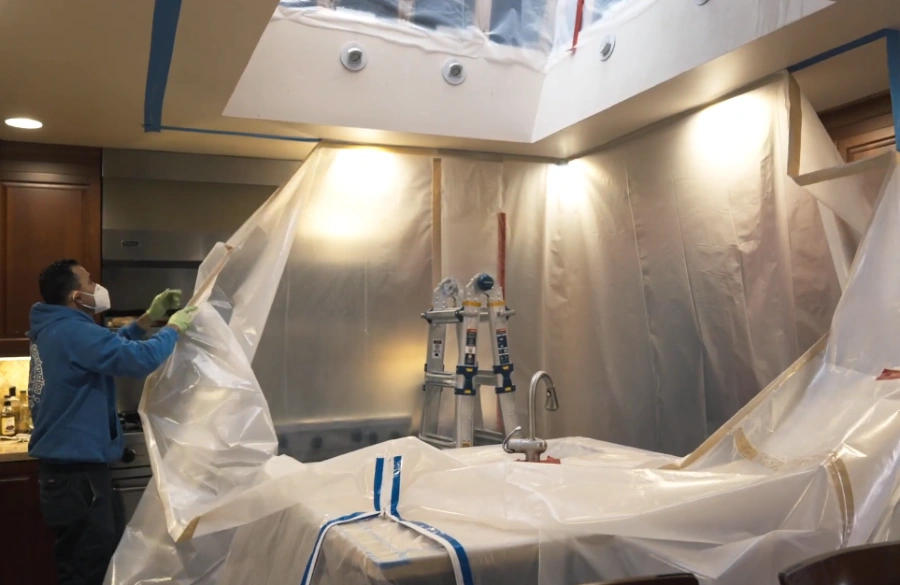
Polyethylene containment barriers seal the work area from the rest of your home. Negative air pressure is established — air flows into the containment zone, not out. HEPA air scrubbers run continuously inside the containment. This prevents mold spores from spreading to unaffected rooms during removal.
IICRC S520 containment is required by all major Washington State insurance carriers for mold remediation claims.
Source Removal
Mold-colonized materials that cannot be cleaned are removed in sealed plastic bags inside the containment zone. For Bellevue’s older plaster walls and wood subfloors, this typically means targeted demolition of affected sections — not whole-wall removal. We identify exactly what must come out vs. what can be treated in place, which saves you thousands in unnecessary demolition costs.
Case example: Factoria homeowner saved $4,200 in unnecessary drywall replacement through targeted removal.
HEPA Vacuuming & EPA-Registered Biocide Treatment
All remaining surfaces in the containment zone are HEPA-vacuumed to remove loose spores. EPA-registered antimicrobial biocides are applied to affected structural materials — wood framing, concrete, tile — to prevent regrowth. Encapsulant may be applied to remaining porous materials where appropriate per S520 protocol.
All biocides used are EPA-registered and approved for residential use.
Clearance Testing — Independent Lab Verification
Post-remediation air sampling is collected after containment is removed and compared to your pre-remediation baseline and outdoor control samples. Clearance is achieved when indoor spore counts return to normal background levels. We do not consider a job complete — and will not release the space for reoccupancy — until clearance testing passes. Written clearance report provided for your insurance file and future property disclosure.
Warning Signs
Signs You Have Mold in Your Bellevue Home
You may not see mold growing — but these signals indicate active mold colonization behind walls, under floors, or in crawl spaces.
👶 Musty or Earthy Odor
The most reliable early indicator. Mold produces microbial volatile organic compounds (MVOCs) before becoming visible. Strongest in bathrooms, basements, crawl spaces, and behind kitchen cabinets.
💧 Visible Discoloration
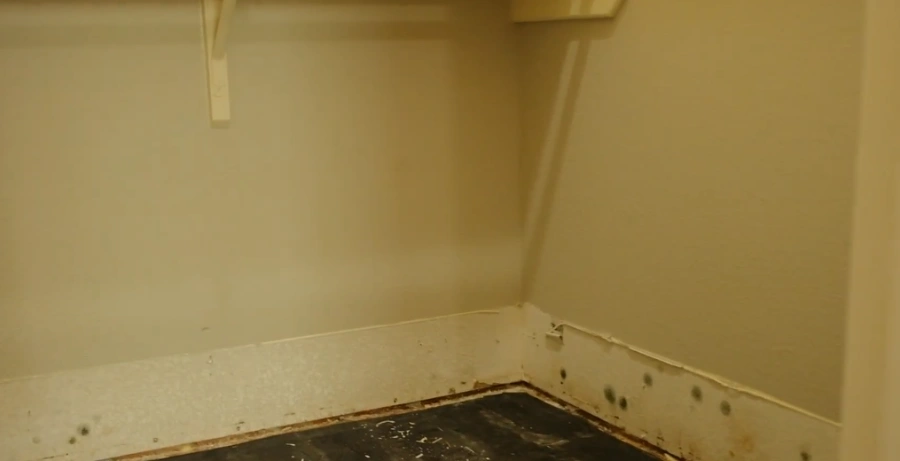
Black, green, grey, or white spots on walls, ceilings, or grout. In Bellevue’s older plaster homes, discoloration may appear as subtle staining rather than obvious growth. Check behind furniture near exterior walls.
🌙 Warping, Buckling, or Soft Spots
Soft spots in drywall, warping baseboards, or buckled hardwood floors indicate active or recent moisture retention. In Crossroads and Lake Hills, galvanized pipe leaks create soft spots in walls that appear dry on the surface.
🧠 Allergy or Respiratory Symptoms
Worsening asthma, persistent cough, sneezing, or eye irritation that improves when you leave home. Mold spores become airborne when disturbed and circulate through HVAC systems. Children and elderly are most affected.
📺 Previous Water Damage
Any water damage event within the past 6 months that was not remediated by an IICRC-certified contractor. Even if “dried out,” delayed response often leaves mold behind walls that becomes active months later.
🏠 Crawl Space Conditions
Standing water, wet vapor barriers, or visible growth on floor joists in Crossroads and Lake Hills crawl spaces. Annual inspection recommended for any home near Kelsey Creek watershed, especially Oct–Mar atmospheric river season.
Do Not DIY Mold Removal
Disturbing mold without proper HEPA containment releases spores throughout your home, spreading contamination to previously unaffected areas. Bleach does not kill mold roots on porous surfaces — it removes color while leaving active colonization. DIY attempts also void most insurance coverage for mold remediation, as carriers require IICRC S520 protocol documentation.
Mold Cost & Insurance
How Much Does Mold Remediation Cost in Bellevue — and Does Insurance Cover It?
Cost depends on area affected and when the mold is discovered. Insurance coverage depends on when the original water damage occurred and whether duty-to-mitigate was fulfilled.
Key rule: If mold resulted from a covered sudden water damage event (burst pipe, appliance failure) and you called a restoration company promptly, mold remediation is typically covered under your homeowners policy as part of the water damage claim. If mold developed from a gradual leak or delayed response, coverage is often disputed. Our same-day response and documentation eliminates the “delayed response” dispute.
Mold FAQs
Mold Remediation FAQs — Bellevue, WA
How quickly does mold grow after water damage in Bellevue?
In Bellevue’s Oct–Mar humidity of 65–80%, mold begins colonizing wet materials in 20–24 hours — faster than the national 24–48 hour standard. Aspergillus, Penicillium, and Cladosporium are the most common species. Same-day extraction eliminates mold risk on most jobs. If we are on-site within 60 minutes of your call, mold remediation is usually not needed.
Does homeowners insurance cover mold remediation in Washington State?
Yes, if mold resulted from a covered sudden water damage event and you responded promptly. Standard Washington homeowners policies cover mold remediation when it is a direct result of a covered water event (burst pipe, appliance failure). If mold developed from a gradual leak or you delayed calling a restoration company, coverage is often disputed. Our same-day response documentation eliminates the delayed-response dispute entirely.
What is IICRC S520 mold remediation protocol?
IICRC S520 is the industry standard for mold remediation, published by the Institute of Inspection, Cleaning and Restoration Certification. It specifies requirements for inspection, air sampling, containment setup, personal protective equipment, source removal, antimicrobial treatment, air scrubbing, and clearance testing. Most Washington insurance carriers require S520 protocol documentation to approve mold remediation claims. Non-certified contractors produce documentation adjusters reject.
Can I stay in my Bellevue home during mold remediation?
For minor, contained mold in a single room, occupancy is often possible in unaffected areas of the home. For extensive mold involving multiple rooms, HVAC contamination, or Stachybotrys (black mold), temporary relocation is strongly recommended. We assess each situation during initial inspection and provide a written recommendation. Additional living expense (ALE) coverage in your homeowners policy may cover temporary housing — ask us to document this in your claim scope.
Which Bellevue neighborhoods have the highest mold risk?
Crossroads and Lake Hills have the highest mold risk due to the Kelsey Creek watershed, aging 1962–1978 construction with galvanized plumbing and cellulose insulation, and vented crawl spaces. Wilburton is second-highest due to Mercer Slough proximity and high water table in wet winters. Factoria and Somerset have elevated risk from Coal Creek drainage. All five neighborhoods should have annual crawl space inspections, especially after atmospheric river storm events Oct–Mar.
How long does mold remediation take in Bellevue?
Minor mold remediation in a single room typically takes 2–4 days including containment setup, removal, treatment, and clearance testing. Moderate jobs (2–3 rooms) run 4–7 days. Extensive crawl space or multi-room mold can take 7–14 days. Clearance testing results from the lab take 24–48 hours. We do not release spaces for reoccupancy or reconstruction until clearance passes — no shortcuts.
Can mold grow back after remediation in Bellevue?
Mold can return if the moisture source is not permanently addressed. After every remediation job, we identify and document the original moisture source. If the source was a plumbing failure, it must be repaired before reconstruction. If it was a crawl space moisture issue, vapor barrier replacement and ventilation correction are part of the scope. Clearance testing confirms spore counts are at normal background levels before we consider the job complete.
24-Hour Mold Window
Same-Day Response Eliminates Mold Risk
In Bellevue’s humid climate, every hour matters. If we are on-site within 60 minutes of your call, mold remediation is usually not needed. Call now — a live person answers 24 hours a day.
IICRC S520 Certified · WA License #NATIORC792M6 · 15700 Bel-Red Rd, Bellevue WA 98008 · [email protected] · 24/7/365